 Hugh Kinnins
Canada’s labour market has changed in recent years. Many sectors that once relied on local workers now depend heavily on international applicants who are ready to take on roles that do not require formal training. Despite the common description of these positions as “unskilled,” employers often see them as indispensable. They keep farms running, support factories, maintain food supply chains, and ensure that the country’s hospitality and caregiving systems stay afloat.
Foreign workers who hope to build a future in Canada often begin through these routes. The pathway can be practical, especially for candidates who may not meet the academic or professional standards required for skilled immigration programs. While the process involves several steps and strict rules, many employers continue to provide sponsorship through the Labour Market Impact Assessment (LMIA) system, which allows them to hire workers from abroad when local recruitment falls short.
This guide explains these opportunities in a clear manner.
Understanding “Unskilled” Jobs in Canada
Canada does not officially label jobs as “unskilled.” Instead, the government uses a classification known as the National Occupational Classification (NOC). Roles that fall under Training, Education, Experience, and Responsibilities (TEER) categories 4 and 5 are often considered entry-level. They rarely require formal training or previous work experience.
Examples include:
- Food processing labourers
- Farm workers and harvesters
- Meat-packing and poultry plant workers
- Cleaning staff
- Construction helpers
- Warehouse labourers
- Care aides and support workers
- Housekeepers
- Retail shelf stockers
- Seasonal hospitality staff
These positions make up a notable percentage of Canada’s labour shortages. For this reason, employers in these sectors are permitted to recruit foreign workers and support them with the paperwork needed to obtain a temporary work permit.
How Visa Sponsorship Works for Unskilled Jobs
Canada does not offer a separate “visa sponsorship” document. Instead, sponsorship occurs when an employer applies for and receives a positive LMIA. This document confirms that the company tried to hire locally but could not find a suitable candidate.
Once the LMIA is approved, the worker may apply for a work permit. The employer must provide:
- A valid job offer
- A copy of the LMIA decision
- The LMIA number
- A written contract
This combination is what many applicants informally call “visa sponsorship.”
Most Common Unskilled Jobs That Offer Sponsorship
1. Agricultural and Farm Jobs
Agriculture remains one of the strongest sources of employer sponsorship. The Seasonal Agricultural Worker Program (SAWP) and general agriculture streams allow farms to hire international candidates.
Typical roles include:
- Fruit and vegetable pickers
- Greenhouse labourers
- Livestock attendants
- Grain farm helpers
Work is often physically demanding but steady. Many workers return seasonally and may transition to longer-term opportunities.
2. Food Processing and Factory Jobs
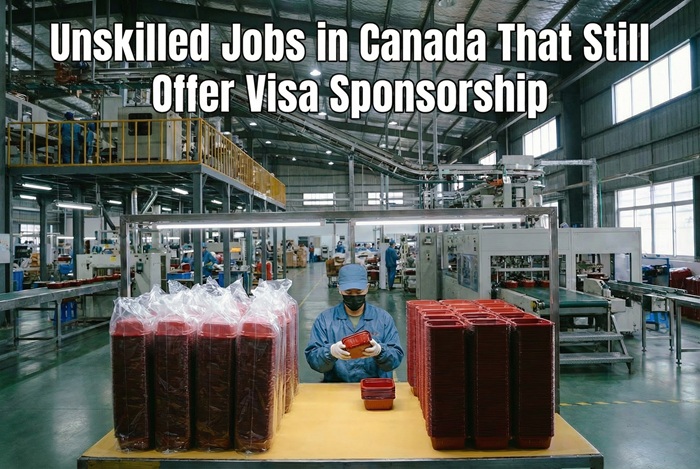
Food plants frequently struggle to maintain enough staff. Foreign workers fill roles such as:
- Meat cutting assistants
- Packaging workers
- Line operators
- Quality control assistants (entry-level)
These jobs usually take place in controlled environments and require attention to detail but not advanced training.
3. Hospitality and Cleaning Roles
Hotels, restaurants, and cleaning companies often sponsor workers through LMIA when turnover is high.
Common roles include:
- Room attendants
- Dishwashers
- Kitchen helpers
- Janitorial staff
- Housekeeping aides
These positions are available in every province, especially in areas with large tourism industries.
4. Warehouse and Logistics Jobs
Canada’s growing e-commerce sector has expanded the need for:
- Order pickers
- Packaging staff
- Shipping helpers
- Inventory assistants
Employers in rural or industrial zones are usually more willing to hire foreign workers due to shortages.
5. Caregiving and Support Roles
While professional caregiving requires credentials, many entry-level support roles exist for:
- Elderly care assistants
- Disability support helpers
- Home support aides
Some employers provide LMIA for individuals who can show basic caregiving experience, even if informal.
Requirements for Unskilled Jobs With Sponsorship
While requirements vary by employer and province, most sponsored workers must meet the following:
1. A Valid Job Offer
Your offer must include:
- Job title
- Duties
- Salary
- Working hours
- Duration of employment
2. LMIA
This is the employer’s responsibility. However, workers must submit the LMIA number when applying for a work permit.
3. Proof of Identity
You must have:
- A valid passport
- A recent passport photo
- Evidence of your legal status in the country where you apply
4. Educational Requirements
Entry-level jobs rarely require formal education. However, you should be able to show:
- Basic literacy
- Ability to follow instructions
- Physical ability for jobs that require lifting or long hours
5. Experience Requirements
Some employers accept applicants with no prior experience. However, experience can help strengthen your application, such as:
- Farm work in your home country
- Cleaning or household jobs
- Caregiving for family members
- Retail or hospitality roles
Immigration officers may ask for evidence that you can support yourself upon arrival. Bank statements are usually accepted.
7. Background Check
Police clearance certificates from your country of residence are standard.
8. Medical Examination
Jobs that involve food, agriculture, health support, or close contact with people require medical checks from an approved doctor.
Documents You Need to Apply
Your work permit application will likely require the following:
- Passport
- Job offer letter
- Copy of the LMIA decision
- LMIA number
- Police certificate
- Medical exam results (if required)
- Proof of funds
- Passport photographs
- Resume or CV
- Application forms (IMM 1295 or relevant substitutes)
If you are applying from outside Canada, you may also need:
- Family information forms
- Travel history documentation
Application Steps: How and Where to Apply
1. Find an Employer Willing to Sponsor
You can search through:
- Canadian Job Bank
- Provincial job portals
- Employer websites
- Recruitment agencies authorized to hire foreign workers
- Agricultural worker programs
Choose only verified employers. Avoid offers that promise sponsorship in exchange for large fees. Workers should never pay for an LMIA.
2. Employer Applies for LMIA
Your employer submits an application to Employment and Social Development Canada (ESDC). If approved, they receive:
- A positive LMIA
- A reference number
Employers forward these to you.
3. Apply for a Work Permit
You apply online through the Immigration, Refugees and Citizenship Canada (IRCC) portal.
Submit all required documents, including the LMIA.
4. Biometrics
You will receive a request to visit a local visa application centre.
5. Wait for Processing
Processing times vary by country. Unskilled streams may take longer due to high demand.
6. Receive Your Work Permit
If approved, your letter of introduction will be issued. The actual permit is given at the port of entry when you arrive in Canada.
Processing Time
Processing times depend on:
- Your country of application
- The type of work permit
- Required background checks
Average timelines range from 8 weeks to several months. Seasonal agricultural programs may be faster.
Fees for LMIA and Work Permit
Employer Fees
- LMIA fee: CAD 1,000 per worker
- Advertising costs (varies)
Employers must cover these. Workers should not pay this fee.
Worker Fees
- Work permit application: CAD 155
- Biometrics: CAD 85
- Medical exam: Varies (usually CAD 100–300)
- Police certificate: Varies by country
When to Apply (Deadlines and Timing)
There is no single national deadline for unskilled jobs. However:
- Seasonal agricultural jobs follow farming cycles
- Hospitality peaks before summer and winter holidays
- Food-processing plants hire year-round
- Warehousing increases during retail seasons
Apply early, especially if your field has predictable peak periods.
Pathways to Permanent Residence (PR) From Unskilled Jobs
Though unskilled work permits do not directly grant permanent residence, there are long-term possibilities:
- Provincial Nominee Programs (PNP)
- Atlantic Immigration Program (AIP)
- Rural and Northern Immigration Pilot (RNIP)
- Agri-Food Pilot
Workers with strong performance records often receive extended contracts that support future immigration applications.
How to Strengthen Your Chances Before Applying
- Prepare a clear and simple resume
- Obtain letters of reference from past employers
- Complete basic English language tests if possible
- Research the employer and industry to understand expectations
- Arrange funds to meet proof-of-support requirements
Important Notice: Unskilled jobs in Canada provide a realistic starting point for many foreign workers. The process requires patience, accurate documentation, and an employer willing to go through LMIA procedures. Canada’s economy continues to depend on labour in agriculture, food processing, hospitality, caregiving, and warehousing, creating openings for individuals ready to take on these roles.
While the path may not be glamorous, it offers a genuine chance to build a foundation in a stable country with long-term possibilities. With proper preparation and reliable information, applicants can navigate the system effectively and increase their chances of a successful move.
The article cited the following authoritative sources:
1. Canada.ca – Temporary Foreign Worker Program (TFWP)
https://www.canada.ca/en/employment-social-development/programs/temporary-foreign-worker.html
2. Canada.ca – Seasonal Agricultural Worker Program (SAWP)
3. Canada.ca – Hiring Low-Wage Temporary Foreign Workers (LMIA)
https://www.canada.ca/en/employment-social-development/services/foreign-workers/median-wage/low.html
4. Job Bank – Temporary Foreign Workers Listings
https://www.jobbank.gc.ca/jobsearch/jobsearch?fsrc=32
5). Labour Market Impact Assessment (LMIA) – Wikipedia
https://en.wikipedia.org/wiki/Labour_Market_Impact_Assessment


 Hugh Kinnins