 Hugh Kinnins
One of the most important components of a visa application is proof of funds. Immigration officials want to be sure that an applicant can sustain themselves financially without having to work illegally, use public assistance, or stay longer than they should because they are having trouble. This requirement is true for all countries and visa types. Many applications that would otherwise be strong fail because the financial data is not clear, consistent, or well explained.
Showing wealth is not what proof of finances is about. It’s about establishing that the money is stable and legitimate and that you have control over it. Immigration officials are taught to look at more than just balances. They also look at patterns, sources, and reliability. A small quantity of money shown correctly can be more convincing than a large amount of money shown wrong.
This article goes at length to explain what proof of funds for a visa is, what documents are normally accepted, and how to get a suitable proof of funds letter successfully.
What Proof of Funds Means in Visa Applications
Proof of funds refers to documentary evidence that shows you have sufficient financial resources to cover your expenses for the duration of your stay abroad. These expenses usually include accommodation, food, transportation, tuition where applicable, and return travel.
Immigration authorities use proof of funds to answer several questions:
- Can the applicant support themselves legally
- Is the money accessible and under the applicant’s control
- Is the source of funds lawful and credible
- Does the financial profile match the purpose of travel
Proof of funds is therefore both a financial and a credibility test.
Why Proof of Funds Is So Important
Visa decisions are risk-based. Authorities view financial weakness as a risk factor for illegal work, overstaying, or reliance on public resources. If an applicant’s finances are unclear, they may face rejection even with strong academic or professional backgrounds.
Proof of funds also helps authorities assess intent. For instance, authorities may perceive a visitor as high risk if they indicate a brief stay but lack stable income or savings. A student with no realistic means of support may raise concerns about compliance.
When proof of funds is clear and well documented, it reduces uncertainty and speeds up decisions.
Common Visa Types That Require Proof of Funds
Most visa categories require some form of financial evidence.
These commonly include:
- Visitor and tourist visas
- Student visas
- Work visas and sponsored employment visas
- Family reunification visas
- Permanent residence or settlement applications
The amount required and the form of evidence depend on the visa type and destination country.
What Immigration Officers Look for in Proof of Funds
Immigration officers do not simply check the balance. They examine financial evidence holistically.
They look for:
- Consistency over time
- Clear ownership or control of funds
- Lawful sources of income
- Alignment with the stated purpose of travel
- Absence of suspicious transactions
Sudden large deposits, borrowed funds, or unclear sponsorship arrangements often trigger closer scrutiny.
Acceptable Documents for Showing Proof of Funds
Proof of funds usually involves more than one document. The goal is to create a clear financial picture rather than rely on a single piece of paper.
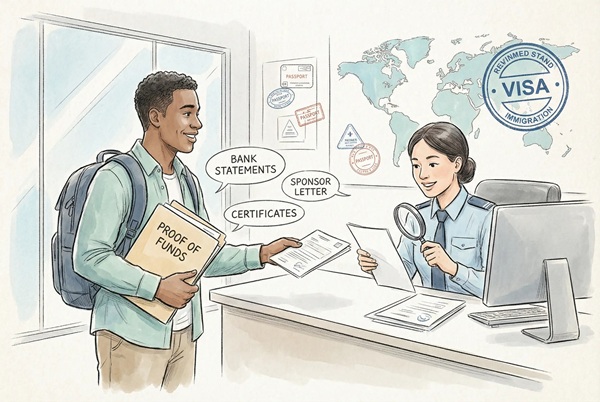
Bank Statements
Bank statements are the most commonly used proof of funds document.
Strong bank statements typically show:
- The applicant’s name
- Account number
- Bank name and logo
- Transaction history
- Opening and closing balances
Most immigration authorities prefer statements covering three to six months.
Bank Balance Certificates
Some banks issue official balance certificates stating the current balance on a specific date. These can support bank statements but rarely replace them entirely.
Proof of Income
Income documents show how funds are generated and sustained.
These may include:
- Payslips
- Employment letters
- Business income records
- Rental income statements
Regular income strengthens the credibility of savings.
Tax Records
Tax returns or official tax summaries help demonstrate that income is lawful and declared. These are particularly useful for self employed applicants.
How to Obtain a Proof of Funds Letter From a Bank
A proof of funds letter, sometimes called a bank letter or bank confirmation letter, is an official document issued by a financial institution confirming the existence and status of an account.
What a Proof of Funds Letter Usually Contains
A proper proof of funds letter should include:
- Bank name and address
- Applicant’s full name
- Account number or masked number
- Date the account was opened
- Current balance
- Bank stamp or seal
- Authorized signature
Some banks also include average balances over a specified period.
How to Request a Proof of Funds Letter
The process varies by bank, but it generally involves the following steps:
- Visit your bank branch or online banking portal
- Request an official bank letter for visa or immigration purposes
- Confirm the required details with the bank officer
- Pay any applicable service fee
- Collect the letter or receive it electronically
It is important to request the letter close to your visa application date, as many embassies require recent documents.
Common Mistakes With Proof of Funds Letters
Applicants often submit letters that are rejected because:
- They lack official stamps or signatures
- They do not show the balance clearly
- They are outdated
- They are printed on plain paper without bank identification
Always review the letter carefully before submission.
Showing Proof of Funds With a Sponsor
Some visa applicants rely on a sponsor rather than personal savings. Sponsors may include parents, spouses, employers, or institutions.
Acceptable Sponsor Documents
When using a sponsor, immigration authorities usually require:
- Sponsor’s bank statements
- Sponsor’s proof of income
- Sponsorship or affidavit letter
- Proof of relationship to the applicant
The sponsor must show both willingness and ability to support the applicant.
Risks With Sponsored Funds
Sponsored funds are scrutinized carefully. Authorities assess whether the sponsor’s support is realistic and sustainable.
Weak sponsorship arrangements often fail due to:
- Insufficient sponsor income
- Lack of relationship proof
- Unclear financial obligations
Proof of Funds for Student Visas
Student visas often have clearly defined financial thresholds.
Applicants may need to show:
- Tuition fees paid or reserved
- Living expenses for a set period
- Accommodation costs
Some countries require funds to be held for a minimum period before application. Sudden deposits are often questioned.
Scholarships, grants, and sponsorships can replace personal funds if properly documented.
Proof of Funds for Work Visas
For work visas, proof of funds requirements vary.
Sponsored work visas may require limited personal funds if the employer covers costs. Unsponsored work visas may require more extensive evidence.
Applicants should show:
- Savings for initial settlement
- Salary details from the employer
- Accommodation arrangements if available
Proof of Funds for Visitor Visas
Visitor visas rely heavily on proof of funds because they assess short term intent.
Applicants must show:
- Ability to cover travel and living expenses
- Strong financial ties to their home country
- Stable income or savings
Inadequate proof of funds is one of the most common reasons for visitor visa refusals.
Using Fixed Deposits and Investments as Proof of Funds
Fixed deposits, savings bonds, and certain investments may be accepted if they are liquid and under the applicant’s control.
Documents should clearly state:
- Ownership
- Value
- Maturity date
- Withdrawal conditions
Non-liquid assets such as property usually do not count unless they generate income.
Common Reasons Proof of Funds Is Rejected
Even when applicants believe their finances are sufficient, refusals still occur.
Common reasons include:
- Unexplained large deposits
- Borrowed funds
- Inconsistent statements
- Third party accounts without authorization
- Documents that cannot be verified
Transparency is critical. If something looks unusual, explain it with evidence.
How to Strengthen Your Proof of Funds
Applicants can significantly improve their chances by preparing early.
- Maintain consistent balances over time
- Avoid last minute deposits
- Use official bank documents
- Ensure all names and details match
- Provide explanations for irregularities
Clear financial planning often matters more than the total amount shown.
Writing an Explanation Letter for Proof of Funds
In some cases, a short explanation letter can clarify financial details.
This letter may explain:
- Recent income changes
- Bonuses or asset sales
- Business income fluctuations
The tone should be factual and supported by documents. Avoid emotional language.
Digital Bank Statements and Online Accounts
Many applicants now use online banks or digital statements. These are often accepted if they meet embassy requirements.
Statements should be:
- Downloadable in PDF format
- Clearly branded with bank details
- Verifiable if requested
Screenshots are usually not accepted.
How Immigration Officers Assess Financial Credibility
Immigration officers compare proof of funds against the rest of the application.
They assess whether:
- The funds match the travel plan
- The financial profile matches the applicant’s background
- The source of funds is logical
Inconsistencies between finances and declared intentions often lead to refusal.
When you apply for a visa, showing proof of funds doesn’t mean showing the biggest sum you can. It means giving clear, legal, and well-documented proof of your finances that supports your reason for traveling.
A robust evidence of funds package include bank statements that are consistent, income records that are reliable, and, if necessary, a properly issued proof of funds letter. When sponsorship is involved, it’s important to write down all of the relationships and duties.
Proof of funds, when done right, gives immigration officials peace of mind and makes the whole case stronger. If done wrong, it can hurt even the strongest argument. Always remember, being transparent about your financial situation is a sign of credibility when applying for a visa.
Editor’s Note:
The truth is that proof of funds is one of the most critical parts of any visa application. Personally, I see it as both a financial and a credibility test. You should note that when submitting proof of funds, immigration officials want to be confident that you can support yourself legally throughout your stay without working illegally, relying on public assistance, or overstaying because of financial pressure. Many strong applications fail simply because the financial evidence is unclear, inconsistent, or poorly explained.
I understand that proof of funds is not about showing wealth. It is about showing stability, legitimacy, and control over your money. The reality is that immigration officers look beyond the final balance. They assess patterns, sources of income, and whether your finances realistically match the purpose of your travel. There is no doubt that a smaller amount presented clearly and honestly is more convincing than a large sum that appears sudden or unexplained.
When you show proof of funds, you are expected to demonstrate that you can cover key expenses such as accommodation, food, transportation, tuition if applicable, and return travel. Officers use this evidence to confirm that your funds are accessible, lawfully earned, and appropriate for the visa type you are applying for.
You must know that most visas require proof of funds, including visitor, student, work, family, and settlement visas. Officers typically examine bank statements over several months, proof of income such as payslips or employment letters, and sometimes tax records. A proof of funds letter from your bank can also help, provided it is recent, official, and properly signed.
If you rely on a sponsor, you must clearly document the relationship and show that the sponsor has both the means and willingness to support you. Officers develop doubts when scrutinizing weak or unclear sponsorship arrangements.
Overall, I see proof of funds as a way to build trust. Consistent, transparent, and well-explained financial documents alleviate uncertainty and fortify your entire visa application. Get Started Here to read what the UK government says about proof of funds.
Authoritative sources used in the article:
Government guidance on proof of funds requirements and acceptable documents
https://www.canada.ca/en/immigration-refugees-citizenship/services/immigrate-canada/express-entry/documents/proof-funds.htmlDetails on acceptable proof of funds for immigration and settlement purposes
https://www.canadim.com/settlement-funds/Requirements for proof of financial support in visa applications
https://www.mpowerfinancing.com/blog/proof-of-financial-support-how-to-show-funds-for-your-visa-applicationsVisitor visa financial proof checklist
https://www.cicnews.com/2024/02/visitor-visa-checklist-everything-you-need-to-apply-and-visit-canada-0242873.html


 Hugh Kinnins