 Hugh Kinnins
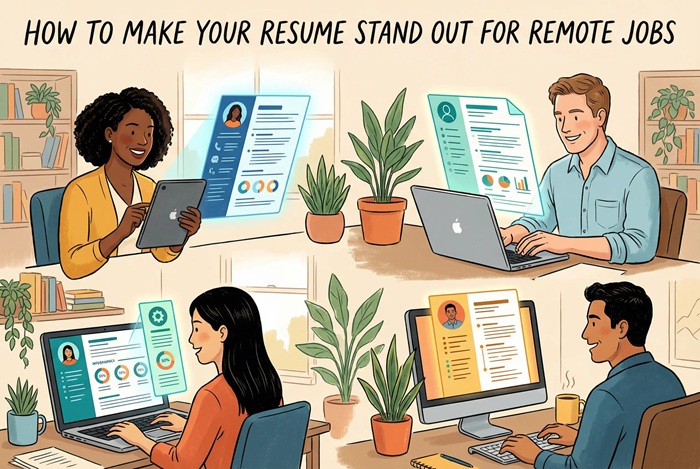
In many industries, remote work has evolved from a short-term fix to a long-term hiring strategy. Nowadays, businesses hire people all over the world, oversee remote teams, and assess applicants without ever meeting them in person. This development has led to a change in the way companies read, screen, and evaluate resumes. A resume that excels in a local office setting often performs poorly when applied to remote positions.
Your resume needs to do more than just list experience if you want to stand out in the remote hiring market. It must convey autonomy, dependability, effective communication, and quantifiable results. Employers who use remote hiring are controlling risk. They want proof that you can work with people in different time zones, produce results on your own, and write clearly.
This article covers in detail how to create a resume that works well for remote jobs. It also covers topics such as structure, content strategy, keyword alignment, evidence of remote readiness, and typical errors that subtly eliminate otherwise excellent applicants. What we recommend here is applicable to all industries and levels of experience.
Why Remote Hiring Changes Resume Evaluation
Remote employers face challenges that do not exist in traditional office hiring. They cannot rely on physical presence, informal check-ins, or visual cues. As a result, they depend heavily on documentation during the screening phase. Your resume becomes a proxy for your work habits.
Remote recruiters look for signals that answer practical questions. Can this person manage their time? Can they communicate without constant meetings? Can they work independently and still deliver consistent results?
Because of this, resumes for remote jobs are screened more strictly. Applicant tracking systems still play a role, but human reviewers are especially sensitive to clarity, credibility, and evidence. Vague language and generic claims perform poorly.
A strong remote resume reduces uncertainty. It shows how you work, not just where you worked.
Choosing the Right Resume Format for Remote Roles
The preferred resume format for remote jobs is the reverse-chronological format. This format presents your most recent work first and allows employers to assess relevance quickly. It also supports applicant tracking systems, which are widely used in remote hiring.
Functional resumes are rarely effective for remote roles. They hide timelines and make it difficult to verify experience. Hybrid resumes can work, but only if the skills section is brief and supported by clear job history.
For remote roles, employers want continuity and accountability. A clear timeline builds trust.
Your resume should include standard sections in this order:
- Professional summary
- Core skills
- Work experience
- Education
- Certifications or training
Avoid creative layouts, columns, icons, or visual elements. Remote hiring often involves multiple tools and devices. A simple, text-based layout ensures compatibility and readability.
Writing a Professional Summary That Signals Remote Readiness
The professional summary is one of the most important sections for remote jobs. Recruiters often read it before anything else. It should answer three questions quickly. What do you do? How do you do it? Why are you effective in a remote setting?
A strong remote-focused summary is concise and specific. It avoids buzzwords and focuses on outcomes.
For example:
Project manager with eight years of experience leading distributed teams across three continents. Proven track record of delivering complex software projects on time using asynchronous workflows and clear documentation.
This type of summary communicates role identity, experience level, and remote capability without exaggeration.
Avoid statements like “seeking a remote opportunity” or “passionate about working from home.” Employers care about performance, not preference.
Highlighting Remote-Relevant Skills Without Keyword Stuffing
Remote job descriptions often include specific skills related to collaboration, communication, and workflow. These keywords matter, but how you use them matters more.
Instead of listing generic skills, integrate them into context.
Weak example:
- Remote communication
- Time management
- Team collaboration
Strong example within experience:
Coordinated weekly project updates using written status reports and asynchronous communication tools, reducing meeting time by 30 percent while maintaining delivery schedules.
This approach shows skill through action. It also aligns naturally with applicant tracking systems without appearing artificial.
Remote employers value skills such as written communication, task prioritization, documentation, self-management, and tool proficiency. However, these should always be supported by evidence.
Demonstrating Remote Work Experience Effectively
If you have prior remote or hybrid experience, it should be clearly labeled. Do not assume employers will infer it.
Include indicators such as:
- Remote
- Fully remote
- Distributed team
- Global team
Place these descriptors next to job titles or employer names where appropriate.
More importantly, describe how the remote environment shaped your work. Mention time zones, collaboration methods, and outcomes.
For example:
I have worked remotely with a cross-functional team across five time zones, delivering monthly product releases through structured documentation and milestone tracking.
If you do not have formal remote experience, focus on elements that translate well. Independent projects, freelance work, consulting, and roles with minimal supervision all apply.
Remote readiness is about behavior, not location.
Using Metrics to Build Trust at a Distance
Remote hiring increases skepticism. Employers cannot observe you in an office, so they rely on measurable results.
Every role should include quantified outcomes where possible.
Examples include:
- Revenue growth
- Cost reduction
- Time savings
- Efficiency gains
- Customer satisfaction scores
- Project delivery timelines
Metrics provide objectivity. They reduce reliance on subjective language and help employers compare candidates fairly.
Even in non-technical roles, metrics are available. Editorial roles can cite output volume. Support roles can reference resolution time. Operations roles can reference process improvements.
A resume without metrics often reads as untested, regardless of experience level.
Optimizing for Applicant Tracking Systems in Remote Hiring
Remote roles attract high application volumes. Many companies rely heavily on applicant tracking systems to manage this flow.
To ensure your resume passes initial screening:
- Use standard section headings
- Avoid tables, text boxes, and graphics
- Use common job titles
- Save your resume as PDF or DOCX unless otherwise stated
ATS systems also evaluate relevance. This means your resume should mirror the language of the job description without copying it directly.
For example, if a job description emphasizes “asynchronous collaboration,” your resume should include that phrase in a natural way if it reflects your experience.
The goal is alignment, not manipulation.
Addressing Time Zones and Availability Carefully
Time zone compatibility matters for many remote roles. However, it should be handled with care.
Do not include personal scheduling constraints unless requested. Instead, demonstrate flexibility through experience.
For example:
Supported clients in North America and Europe by coordinating deliverables across overlapping business hours.
This signals adaptability without limiting your appeal.
Avoid listing availability windows on your resume. These discussions belong later in the hiring process.
Emphasizing Communication Skills Through Writing Quality
For remote roles, your resume is a writing sample. Poor grammar, unclear phrasing, or inconsistent formatting are more damaging than in traditional hiring.
Employers assume that written communication reflects daily work habits. A sloppy resume suggests sloppy documentation, unclear updates, and avoidable misunderstandings.
Use clear sentences. Avoid exaggerated language. Be precise.
Read your resume aloud. If a sentence feels vague, it probably is.
Consistency also matters. Use the same tense, formatting, and structure throughout. Remote employers value predictability.
Showcasing Tools Without Overloading the Resume
Remote jobs often require familiarity with specific tools. These might include project management platforms, communication tools, or cloud-based systems.
List tools selectively. Focus on those relevant to the role.
Instead of a long tools list, integrate them into experience.
For example:
Managed sprint planning and task tracking using Jira, maintaining on-time delivery across six consecutive release cycles.
This shows both tool usage and outcome.
Avoid listing tools you have only used briefly. Remote employers expect functional proficiency.
Handling Employment Gaps Transparently
Remote hiring increases scrutiny around gaps. Employers want to understand continuity and reliability.
If you have gaps, address them through clarity, not explanation. Use dates accurately. If you worked on freelance projects, education, or caregiving, include them honestly.
For example:
Independent consultant
March 2022 to February 2023
Then describe the work performed.
Avoid leaving unexplained gaps or compressing timelines. Transparency builds credibility.
Tailoring Your Resume for Each Remote Application
Remote roles vary widely in structure and expectations. A one-size-fits-all resume performs poorly.
Tailoring does not mean rewriting from scratch. It means adjusting emphasis.
For one role, communication may matter most. For another, technical output may dominate. Reorder bullet points to match priorities.
This approach improves both ATS performance and human engagement.
It also signals genuine interest.
Common Resume Mistakes That Hurt Remote Applications
Many candidates fail to advance not because they lack skill, but because their resume introduces doubt.
Common issues include:
- Generic summaries
- Overuse of buzzwords
- Unverified claims
- Design-heavy layouts
- Missing metrics
- Poor writing quality
Another frequent mistake is treating remote work as a benefit rather than a responsibility. Employers hire remotely to achieve results, not to offer flexibility.
Your resume should reflect that mindset.
What to Review Before Submitting Your Resume
Before applying to a remote role, review your resume using this checklist:
- Is the format simple and readable?
- Does the summary signal remote capability?
- Are outcomes clearly measured?
- Is the language specific and credible?
- Does the resume align with the job description?
If any of these answers is no, please revise before submitting.
Employers don’t demand perfection when hiring people remotely. They seek consistency and reliability.
It doesn’t take creative wording or an eye-catching layout to make a resume stand out for remote positions. It depends on alignment, clarity, and proof.
Distance doesn’t matter when your resume highlights your work style, communication style, and accomplishments.
The best remote resumes focus on just one area. They give you a sense of security when hiring.
Authoritative sources used in the article:
Indeed – How To Write Your Remote Job Resume
https://www.indeed.com/career-advice/finding-a-job/how-to-write-your-remote-job-resumeResumeWorded – The Complete Guide to Listing Remote Work on a Resume
https://resumeworded.com/remote-job-resume-key-adviceNovoResume – 6 Steps to Create a Remote Job Resume
https://novoresume.com/career-blog/remote-job-resumeIndeed – How To Write an ATS Resume (Template and Tips)
https://www.indeed.com/career-advice/resumes-cover-letters/ats-resume-template

 Hugh Kinnins