 Hugh Kinnins
If you’re seeking employment, an internship, or a place to study in Europe, you’ve probably heard the terms “Europass CV” and “European CV” used interchangeably. Many people looking for work think they imply the same thing. Some people think that one is official while the other is not. Some firms ask for a “European CV” but don’t say what format they prefer, which makes it challenging for applicants to know what to send.
It’s easy to see why people are confused. There are many languages spoken in the European employment market, and each country has its hiring customs. But it’s important to be clear. If you send in the wrong CV format, it can make a strong application weaker.
In this article, we will explain the difference between a Europass CV and a European CV. We will also explain when to use a Europass CV, when not to use one, and what employers in Europe will really want in 2026.
The Answer
The Europass CV is not exactly the same as the European CV, but it has become the most standardized and widely recognized interpretation of what people mean when they say “European CV.”
In other words:
- Europass CV is a specific, official CV format
- European CV is a general, informal term with no single fixed structure
Understanding this difference is essential if you want to apply confidently across European countries.
What Is the Europass CV?
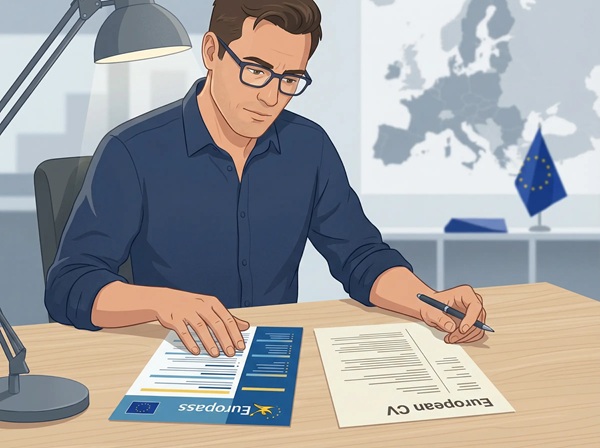
The Europass CV is a standardized curriculum vitae format created and maintained by the European Union through the Europass initiative. It was designed to help people present their skills and qualifications clearly and consistently across Europe.
Europass is supported by the European Commission and is used across EU and EEA countries.
The Europass CV is part of a wider framework that also includes:
- Europass profile
- Europass Language Passport
- Europass Mobility documents
- Digital credentials and certificates
Its core purpose is transparency and comparability across borders.
What Is a “European CV”?
The term European CV does not refer to an official document, template, or platform. It is a descriptive phrase people use to mean:
- A CV suitable for jobs in Europe
- A CV written according to European hiring norms
- A CV that avoids American-style resumes
When an employer says “send a European CV,” they may mean:
- A CV with personal details (common in some EU countries)
- A chronological CV rather than a one-page resume
- A multi-page document covering education and experience
- A format familiar to HR teams in Europe
Because Europe has no single hiring authority, the “European CV” varies by country, sector, and employer.
Why People Confuse the Two
The confusion exists for three main reasons:
- Europass is EU-backed
Many people assume that because Europass is supported by the European Union, it must be the European CV. - Employers use loose language
Employers often say “European CV” when they actually expect a Europass CV, especially in public sector roles. - Cross-border hiring
For international applicants, Europass is often the safest interpretation of “European CV,” so the terms blur over time.
Key Differences Between Europass CV and a European CV
1. Official Status
- Europass CV: Officially developed and maintained by the EU
- European CV: No official authority or standard
2. Structure and Layout
- Europass CV: Fixed structure with predefined sections
- European CV: Flexible structure depending on country and employer
Europass CV sections typically include:
- Personal information
- Work experience
- Education and training
- Language skills
- Digital skills
- Additional information
A European CV may include these sections, but not always in the same order or detail.
3. Design and Formatting
- Europass CV: Clean, uniform, and functional
- European CV: Can range from traditional to modern designs
Many private employers in Europe prefer custom-designed CVs over the Europass format.
4. Length
- Europass CV: Often two to four pages
- European CV: Length varies by country
For example:
- Germany and Austria often accept longer CVs
- The Netherlands and UK prefer shorter CVs
- Southern Europe often accepts more detailed profiles
When Employers Specifically Want a Europass CV
Some employers explicitly require a Europass CV. This is common when applying to:
- EU-funded projects
- Erasmus+ programs
- European institutions
- Public sector roles
- Academic or research mobility programs
If the job posting mentions “Europass CV,” you should always use it.
When Employers Say “European CV” but Mean Europass
In practice, many employers use “European CV” as shorthand for Europass, especially in:
- Cross-border recruitment
- International internships
- NGOs and development organizations
- Universities
In these cases, submitting a Europass CV is usually acceptable and sometimes preferred.
When a Europass CV Is NOT the Best Choice
Despite its legitimacy, the Europass CV is not universally loved.
Many private-sector employers consider it:
- Too long
- Too generic
- Lacking personality
- Difficult to skim quickly
In competitive fields such as marketing, tech, finance, and startups, a tailored CV often performs better.
Country-by-Country Reality in Europe
There is no single European hiring culture.
Western and Northern Europe
Countries like Germany, Sweden, and the Netherlands often prefer:
- Clean, structured CVs
- Clear timelines
- Professional summaries
Europass is acceptable but not always preferred.
Southern Europe
In countries such as Italy, Spain, and Portugal, the Europass format is widely recognized.
- Europass is widely recognized
- Longer CVs are more common
- Personal details are often included
Central and Eastern Europe
Europass remains popular in:
- Public sector roles
- International NGOs
- EU-supported projects
Europass CV vs UK Resume
Although the UK is no longer in the EU, confusion still exists.
- UK employers usually prefer a custom CV, not Europass
- A Europass CV may feel too rigid for UK recruiters
Always adapt to local expectations.
Should You Use Europass or a Custom European CV?
Ask yourself these questions:
- Is this an EU institution or funded program?
- Does the employer explicitly mention Europass?
- Am I applying across multiple European countries?
- Is this an academic or public-sector role?
If yes, Europass is often a safe choice.
If you are applying to private companies, especially startups or multinational firms, a tailored CV usually performs better.
Common Myths About Europass and European CVs
Myth 1: Europass is mandatory in Europe
False. It is optional in most cases.
Myth 2: Europass guarantees interviews
False. It only standardizes presentation.
Myth 3: European CVs must include photos
False. This varies by country and employer.
How Applicant Tracking Systems Handle Europass CVs
One advantage of Europass is that it is:
- ATS-readable
- Clearly structured
- Machine-friendly
However, ATS systems used by private companies may still favor shorter, customized CVs.
Best Practice in 2026: Hybrid Strategy
Many successful applicants now use:
- Europass CV for public, academic, or EU-related roles
- Custom European CV for private-sector applications
This dual approach maximizes reach without risking rejection.
Final Answer: Are They the Same?
To be precise:
- The Europass CV is a standardized, official CV format
- The European CV is a general concept, not a document
The truth is that they overlap in purpose, but they are not identical. When in doubt, read the job posting carefully. If the employer does not specify, research the country, sector, and organization. While the Europass CV and the European CV share a close relationship, they are not interchangeable. Europass is a tool. The European CV is an idea shaped by diverse hiring cultures across Europe. Understanding this distinction allows you to apply with confidence rather than guesswork. The strongest candidates are not those who blindly follow templates, but those who adapt intelligently to expectations. Choosing the right CV format is not about compliance alone. It is about clarity, relevance, and respect for the employer’s context.
Authoritative sources used in the article:
Official Europass overview by the European Union
https://europass.europa.eu/enDetailed guide on the Europass CV structure and purpose
https://enhancv.com/blog/europass-cv/Guide listing Europass within the EU standard CV framework
https://www.comune.venezia.it/en/content/europass-complete-guide-european-curriculum-vitae-and-cover-letter

 Hugh Kinnins