 Hugh Kinnins
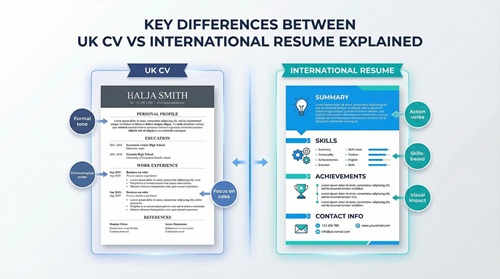
A UK CV and an international resume typically include the same fundamental elements. However, in practice, they adhere to different conventions. UK recruiters appreciate a concise, tailored CV that emphasizes responsibilities and achievements while omitting personal details. International resumes often tend to be shorter, focus more on skills, and may include personal data or photos, depending on the country.
This article provides an explanation of format, length, tone, legal issues, and ATS readiness and includes concrete examples to illustrate how to convert between formats. You, as a job seeker, should be aware that applying from outside the UK could lead to missed opportunities if you use the incorrect format.
What is a CV, and what is a resume
A CV stands for curriculum vitae. The document you send with a job application in the UK is called a CV by default. It is a summary of education, experience, skills, and achievements, and it is adjusted for each role. Government and university career services in the UK present a CV as the main applicant document.
“Resume” is the term more commonly used in the United States and in some other countries. A resume tends to be shorter and more targeted to a specific role or employer. In many non-UK markets, the term “resume” implies a one- or two-page document that focuses on relevant experiences and keywords. Academic applications typically require a longer CV even in the US, but for most private sector roles, the resume is the expected format.
Headline differences at a glance
Name used
- UK: CV is the common term.
- International: A resume is common in the US. Many countries use CV and resume interchangeably.
Length
- UK CV: Typically two pages for experienced professionals. One page may suit early career roles.
- International resume: Often one page for junior roles. Senior candidates use two pages.
Personal details
- UK CV: Do not include date of birth, marital status, sex, or National Insurance numbers. Contact details only. Universities and official UK guidance caution against including sensitive personal data.
- International: Some countries expect a photo, date of birth, or national ID. Always check local norms.
Photos
- UK: Avoid photos unless requested. Photos can trigger bias and are not standard.
- International: Photo inclusion varies by country and industry.
Tone and spelling
- UK: British English spelling and formal but concise tone.
- International: Use the regional dialect and tone expected by the employer.
Purpose
- UK CV: Show fit for a role and match selection criteria.
- Resume: Quickly communicate suitability and relevant accomplishments.
Deep dive: Format and structure
UK CV structure
A practical UK CV typically uses this order
- Contact details
- Personal profile or summary (optional, 2 to 4 lines)
- Key skills or competency summary (targeted bullet points)
- Professional experience in reverse chronological order with achievements listed in bullets
- Education and relevant training
- Additional information such as professional memberships, certifications, publications, or volunteering
- References available on request
British career services recommend that you omit sensitive personal details and keep each section succinct so hiring managers can quickly scan for relevant evidence.
International resume structure
A typical international resume uses
- Contact details
- Resume summary or objective (optional but common in the US)
- Core skills and technical competencies
- Professional experience with key achievements, often quantified
- Education
- Additional sections as needed such as certifications and awards
Length and content: How many pages
- Early career or entry level: One page in most markets works well.
- Mid-career professionals: Two pages is standard in the UK and many international markets.
- Senior, technical, or academic: More pages allowed for detailed publications, patents, or research. For academic roles, the document is called a CV in most countries and can be many pages long.
Personal details and privacy
UK guidance, along with advice from many employers, recommends against including the following:
- Date of birth
- Marital status
- Religion or political affiliation
- NHS or National Insurance numbers
- Photographs unless specifically requested
Removing these details reduces the risk of unconscious bias and keeps your CV compliant with recruitment best practices. Official UK career resources and university advice pages support this approach. Adhere to local norms in countries where photos and personal details are customary.
Spelling, grammar, and language
Use the local form of English that matches the job listing. For UK roles use British spelling; for US roles use American spelling. Tailor idioms and date formats to the region. This is a small step that makes CVs feel native and professional.
Applicant Tracking Systems: ATS tips for UK and international formats
Many employers use ATS software to filter applications. These systems scan for keywords found in the job advert. Best practices include
- Mirror language from the job description for critical technical and role-specific keywords.
- Use standard headings such as “Education,” “Experience,” and “Skills.”
- Avoid images, complex tables, and headers or footers that hide text from parsing.
- Include full words plus common acronyms. For instance, write “Search Engine Optimisation (SEO)” rather than only “SEO.”
- Provide dates of employment in a consistent format.
- UK recruiters and large employers often rely on ATS, so adapt your CV to pass automated checks while keeping it readable for humans.
Tone and achievements: what to emphasise
Write achievement-led bullets rather than lists of duties. Use the STAR pattern when possible
- Situation
- Task
- Action
- Result
Quantify outcomes. For example, “Improved onboarding completion time by 30 percent, reducing churn in the first 90 days” reads stronger than “Managed onboarding.” UK hiring managers seek clear evidence of impact and role fit. University and civil service guidance stresses tailoring to essential criteria.
Converting an international resume to a UK CV
Follow these steps
- Check terminology. Change “resume” to “CV” in your cover letter and any meta fields. Use British spelling.
- Remove sensitive personal details. Omit dates of birth and photos unless the listing asks for them.
- Reorder sections. Put education before experience when applying for graduate roles. For experienced hires, lead with experience.
- Length. Expand to two pages if needed to include responsibilities and achievements, especially when matching essential criteria for public sector posts.
- Localise dates and employer names. Use the UK date format and include the city and country for past employers.
- Keywords. Mirror language in the UK job advert and add relevant UK-specific skills, such as familiarity with UK legislation or sector frameworks if applicable.
- References. Use “References available on request” unless the employer specifically asks for referees.
Converting a UK CV to an international resume
- Condense content. Focus on relevance and reduce peripheral roles.
- Adjust tone. Some markets favour a more direct, marketing-style resume summary.
- Add personal details only when required. For countries that request a photo or nationality, add these.
- One-page rule. For some US entry-level jobs, one page remains the norm. Prioritise the most recent and relevant experience.
- Use local spelling and metrics. Switch to the local language and measurement units.
Examples
Example UK CV bullet before
Managed marketing campaigns across digital and print channels.
Example UK CV bullet after
I spearheaded a cross-channel marketing campaign that resulted in a 22 percent increase in email open rate and a 15 percent increase in qualified leads within a six-month period.
Quantified, result-oriented bullets perform better with both hiring managers and ATS.
Design, fonts, and accessibility
Use clean fonts such as Arial, Calibri, or Georgia. Keep font sizes between 10 and 12 for body text and 14 to 16 for headings. Use clear section headings and adequate white space. A simple one-column layout is easiest for ATS and human readers.
For accessibility, use sufficient contrast and avoid tiny text. Save your CV as a PDF to preserve the layout unless a job advert requests a Word document.
Industry and country variations
- USA: The term “resume” is common. The resume typically consists of one to two pages. References are rarely included.
- Germany: The Lebenslauf often includes a photo and detailed personal information. Dates should be exact.
- France: CVs may include personal data and sometimes photos.
- Middle East: Requirements vary; local norms can favour more personal detail.
- Academic roles worldwide: Use extended CVs that list publications, research, teaching, and funding.
When in doubt, check the employer’s or local career sites. A quick search of the country plus “CV requirements” will save mistakes.
Practical checklist before you submit
- Is contact information clear and professional?
- Have you tailored the CV to the job advert?
- Are achievements quantified and recent?
- Is the document free of spelling errors and formatted for ATS?
- Have you removed sensitive personal data as per UK norms?
- Is your CV saved in a recruiter-friendly format, usually PDF?
Common mistakes to avoid
- Avoid common mistakes such as using a non-professional email address.
- Including unnecessary personal data that may cause bias.
- Sending the same generic CV to multiple roles.
- Excessively using graphics or heavy formatting can disrupt ATS parsing.
- Listing duties instead of accomplishments.
Final conversion checklist with example bullets
To convert international resume to UK CV
- Change spelling to British English
- Remove photo and date of birth unless requested
- Expand bullets with measurable outcomes
- Add UK-relevant keywords and sector terms
- Save as PDF
Example transition
Before resume bullet:
Increased sales in Q4.
After the UK CV bullet:
Increased Q4 sales by 18 percent, delivering an extra 120k in revenue by redesigning the promotional calendar and reallocating budget to top-performing channels.
It is important to note that UK CVs and international resumes are close cousins. The differences are practical and cultural. For the UK, focus on tailored, evidence-led CVs with minimal personal data. For international applications, examine local norms regarding length, photos, and required personal information. When in doubt, mirror the language in the job advert and keep achievements measurable. That approach increases chances with both ATS and hiring managers.
The article cited the following authoritative sources:
Indeed UK — Resume vs. CV: What are the differences?
https://uk.indeed.com/career-advice/cvs-cover-letters/resume-vs-cvNational Careers Service — How to write a CV
https://nationalcareers.service.gov.uk/careers-advice/cv-sectionsmyPerfectCV — Resume vs CV: 8 Key Differences
https://www.myperfectcv.co.uk/blog/resume-vs-cv

 Hugh Kinnins