 Hugh Kinnins
The job market around the world has changed. Now, skilled workers compete not only in cities and countries, but also across borders. Employers in the UK, Canada, Europe, Australia, and parts of Asia actively look for workers from other countries. However, many applicants don’t realise that visa sponsorship adds an extra level of scrutiny. A CV that works great for jobs in your area might not work at all for jobs that require a visa.
It’s not about making your CV longer or more impressive when you update it for global visa-sponsored jobs. It is about making it more clear, more defensible, and easier for employers to explain to immigration authorities. When you sponsor a foreign worker, you are legally responsible, have to pay money, and have to follow the rules. Employers want CVs that lower those risks, not raise them.
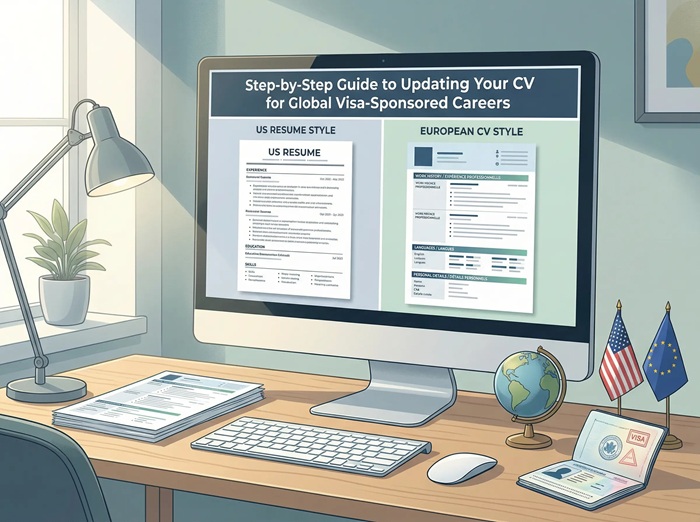
This guide gives you a simple, step-by-step way to update your CV so that it meets the requirements for visa-sponsored jobs around the world.
Step 1: Find out how visa sponsorship changes what employers look for in a CV.
It’s important to know why hiring someone on a visa is different before you make changes.
When an employer sponsors a worker, they usually have to answer to immigration authorities like the UK Home Office, Immigration, Refugees and Citizenship Canada, or the Australian Department of Home Affairs. These organisations want to see proof that:
- The role is real and requires skill.
- The candidate has the right skills.
- The information you gave is correct and consistent.
Your CV is one piece of that proof. If your CV is unclear, overblown, or doesn’t match the job description, the employer may be in danger. Because of this, recruiters are being more careful than usual when looking at visa-sponsored applications.
This information should help you make decisions as you update your CV.
Step 2: Remove personal information that is specific to your country
A lot of CVs don’t get read because they have too much personal information. What is okay in one country may not be okay in another, or it may even be racist.
Please take out the following unless asked to do so
- Date of birth or age
- Sex or marital status
- Picture
- Your national ID or passport number
- Complete address of home
CVs for global visa sponsorship should focus on work skills rather than personal information. Adding too much personal information to your application doesn’t help it and can make employers uneasy.
What to Keep
- Full name
- Email address for work
- Country of residence
- Phone number with an international dialling code
This makes sure that your CV is legal, neutral, and appropriate in many places.
Step 3: Make sure your CV has the same length and structure as everyone else’s.
When it comes to global visa-sponsored jobs, being clear is more important than being creative.
Length that is suggested
For people in the early to middle of their careers: 2 pages
Senior specialists or managers: no more than three pages
Longer CVs take longer to read and make mistakes more likely.
Suggested Structure
- Summary of your work
- Basic skills
- Work experience
- School
- Licenses and certifications
- Extra information (optional)
People in the UK, Europe, Canada, and Australia all agree on this structure.
Step 4: Change the wording of your professional summary for global employers
A recruiter will usually read your professional summary first. For jobs that require a visa, it must quickly answer these three questions:
- What do you do for a living?
- How much experience do you have?
- What makes you a good fit for this job?
Not a good example
“Professional who is motivated and looking for work abroad.”
Good Example
“Mechanical engineer with eight years of experience in maintaining industrial plants. Specialises in safety compliance, preventive systems, and coordinating cross-functional teams in regulated environments.”
The style is factual, clear, and able to withstand an immigration review.
Step 5: Make sure job titles match global and sponsored role standards.
Job titles are very different from one country to the next. In one market, some titles sound senior, and in another, they sound junior.
What to Do
- Use titles that people all over the world will understand.
- Don’t use labels that are only for your company or department.
- Make sure the scope is clear when it needs to be.
Instead of “Technical Officer II,” use “Electrical Maintenance Engineer” with a short explanation of what it means to be senior.
This helps employers identify jobs that they can sponsor.
Step 6: Rebuild your experience section again, but this time around results.
Visa sponsors want proof, not just words.
Use Impact Statements Instead of Task Lists
Don’t make long lists of things to do. Instead, show what you accomplished and how it fits with the job.
Bad example:
“Responsible for keeping an eye on the system and reporting on it.”
A better example:
“Monitored and kept up enterprise systems that ran 24 hours a day, 7 days a week, cutting downtime incidents by 18% over two years.”
Outcome-based descriptions give employers confidence that your skills are real and can be measured.
Step 7: Talk about gaps in employment in a clear and calm way.
It’s common to have gaps in your work history, and they don’t automatically disqualify you. Silence or inconsistency is bad for applications.
How to Deal with Gaps
- Always use the same format for months and years.
- Briefly explain gaps in your work history that are caused by study, caregiving, health, or learning new skills.
- Don’t use language that makes you defensive.
For jobs that require a visa, being open and honest builds trust. Employers would rather have things clear than perfect.
Step 8: Check your CV to make sure your skills are consistent.
A lot of applicants hurt their chances of getting sponsorship by acting like they are new to the field.
Look for These Problems
- Too much use of “assisted,” “supported,” or “helped”
- Not being responsible on your own
- No mention of who owns or makes decisions
The Skilled Worker visa and the Temporary Skill Shortage visa are two examples of frameworks that sponsored roles often fall under. These visas require clearly defined skilled duties.
Make sure your CV shows the right level of professionalism.
Step 9: Make it better for applicant tracking systems
Most employers around the world use ATS software to sort through applications.
Practices that are good for ATS
- Use common headings like “Work Experience”
- Stay away from text boxes, tables, and pictures.
- Put key skills in their own section.
- Say important words again in a natural way
This makes sure that a person looks at your CV.
Step 10: Make the language more local without going too far
Your CV should be neutral around the world, but small choices about where you live do matter.
For example
Say “CV” instead of “resume.”
- Use international spelling when you can.
- Avoid country-specific benefits terminology
This shows that you know about international standards without limiting your CV to one country.
Step 11: Be careful when talking about visa status
A common mistake is to make visa needs the main point of the CV.
Best Practice
Don’t talk about your visa status unless you have to. Keep it short and to the point when you need to.
For example:
“Eligible for a work visa sponsored by an employer, if applicable.”
This keeps the focus on how valuable you are, not what you need to do.
Step 12: Get rid of salary information
Different countries and visa routes have different salary expectations. Including them early can make it harder to talk about sponsorship.
After confirming eligibility and interest, global employers prefer to talk about pay.
Step 13: Read it over with the sponsorship in mind.
When hiring with a visa, small mistakes are more important.
What to Look For
- Grammar and spelling
- Formatting that is always the same
- Correct dates
- Logical progression
Mistakes make people worry about how reliable and detail-oriented they are, both of which are very important in regulated jobs.
Step 14: Carefully add licenses and certifications
When appropriate, professional certifications make visa applications stronger.
Some examples are:
- Status as a chartered or licensed person
- Certifications that are well-known in the industry
- Training for safety or compliance
Don’t list short, low-value courses unless they are directly related.
Step 15: A Final Review from the Point of View of an Employer
Before you send in your updated CV, ask yourself this:
“Does this CV make it easy for an employer to explain why they should hire me?””
If the answer is yes, your CV is ready for job openings that come with a visa.
In conclusion, precision opens borders. Trust is the foundation of global careers. When hiring foreign workers, employers look for people who are clear, honest, and professional. Updating your CV in a structured, compliance-aware way doesn’t guarantee sponsorship, but it does get rid of a lot of the silent barriers that stop applications early. A good global CV doesn’t try to show off. It gives peace of mind. That kind of reassurance is often what gets a candidate from applying to getting an offer.
The article cited the following authoritative sources:
1. UK Home Office
- Skilled Worker visa guidance (employers): https://www.gov.uk/skilled-worker-visa
- Sponsor duties and compliance: https://www.gov.uk/uk-visa-sponsorship-employers
2. Immigration, Refugees and Citizenship Canada (IRCC)
- Hire a foreign worker: https://www.canada.ca/en/employment-social-development/services/foreign-workers.html
- Employer compliance and LMIA overview: https://www.canada.ca/en/employment-social-development/services/foreign-workers/employer-compliance.html
3. Australian Department of Home Affairs
Supports claims about skill level, job classification, and documentation for sponsored roles.
- Temporary Skill Shortage (subclass 482): https://immi.homeaffairs.gov.au/visas/getting-a-visa/visa-listing/temporary-skill-shortage-482

 Hugh Kinnins