 Hugh Kinnins
Qualifications alone rarely determine visa sponsorship in Australia. For most employers, the first and often only document that shapes their decision is the curriculum vitae. A poorly prepared CV can silently terminate an application before any review of skills, experience, or eligibility takes place. Many foreign professionals underestimate how strictly Australian employers assess CVs, especially when sponsorship obligations are involved.
Australian companies that sponsor overseas workers operate under close regulatory oversight. Every sponsored role must meet salary thresholds, skill levels, and genuine position tests. As a result, employers expect CVs to be accurate, clearly structured, and aligned with Australian workplace standards. Small mistakes, often overlooked elsewhere, can raise concerns about credibility, compliance risk, and suitability for sponsorship.
This article examines the most common Australian CV mistakes that can affect visa sponsorship outcomes and explains why these errors matter, how employers interpret them, and what applicants can do to correct them.
Why CV Accuracy Matters More for Visa Sponsorship in Australia
Visa sponsorship places legal and financial responsibilities on the employer. Australian sponsors must demonstrate that the foreign worker is suitably skilled, appropriately paid, and genuinely needed. The CV becomes part of that evidence. When a CV contains inconsistencies, exaggerations, or formatting problems, it does more than weaken a job application. It signals potential compliance risk. Employers may worry that the candidate will not pass skills assessments, English language checks, or Department of Home Affairs scrutiny. For this reason, Australian employers often apply stricter CV screening for sponsored roles than for local hires. A CV that appears careless, inflated, or poorly localized can lead to immediate rejection.
Using a Generic or International CV Format
One of the most common mistakes is submitting a generic international CV without adapting it to Australian expectations. Australian CVs favor clarity, chronological structure, and concise explanations of role responsibilities. Many foreign CVs rely on dense paragraphs, long personal statements, or unconventional layouts. These formats make it harder for recruiters to assess whether the applicant meets sponsorship criteria. Mistakes often include excessive design elements, multi-column layouts that confuse applicant tracking systems, or outdated templates borrowed from other regions. While visual appeal matters, Australian employers prioritize readability and compliance over creative presentation. Overly stylized CVs may come across as unprofessional or unfit for formal sponsorship documentation.
Including Personal Information That Is Not Required in Australia
Another frequent error involves adding unnecessary personal details. In Australia, CVs should not include age, marital status, religion, nationality, or passport numbers. Including such information does not strengthen an application and can create discomfort for employers. Some applicants also attach copies of passports, visas, or national identity cards to their CVs. Australian employers generally request these documents only after a formal offer or sponsorship discussion begins. Excessive personal information suggests unfamiliarity with Australian hiring norms. For sponsored roles, this can raise concerns about the applicant’s understanding of workplace culture and compliance requirements.
Failing to Clearly Match the Role and Occupation List
Australian visa sponsorship relies heavily on occupation classifications. Employers must sponsor roles that align with approved occupation lists, such as the Temporary Skill Shortage list. A major CV mistake is failing to align job titles, responsibilities, and skills with the occupation being targeted. When the CV uses vague or inconsistent job titles, employers may struggle to justify sponsorship under a specific occupation code. For example, a software developer applying under a recognized ICT occupation must clearly show relevant duties, technologies, and experience. Generic descriptions such as “handled IT tasks” provide little evidence for sponsorship purposes. If the CV does not clearly support the nominated occupation, employers may decide that sponsorship approval is too risky.
Exaggerating Skills or Experience
Exaggeration is particularly damaging in Australian sponsorship applications. Employers understand that sponsored workers may face skills assessments, reference checks, and government verification. Inflated job titles, exaggerated responsibilities, or overstated years of experience often surface during background checks. Even minor exaggerations can undermine trust. Australian employers value honesty and consistency. A CV that appears too polished or unrealistically strong may trigger closer scrutiny. In sponsorship contexts, this can lead to rejection in favor of candidates with more transparent profiles.
Ignoring Australian Job Title Conventions
Job titles vary across countries. A title that is common elsewhere may not translate well to Australian employers. Using unfamiliar or inflated titles can confuse recruiters and migration agents. For example, seniority levels differ across regions, and a title like “Lead Engineer” may imply managerial responsibilities that the CV content does not support. When job titles do not align with Australian norms, employers may doubt whether the role genuinely meets sponsorship requirements. Clear, accurate titles supported by detailed responsibilities are essential.
Poor Employment Date Formatting or Gaps
Employment history must be clear, chronological, and easy to verify. Many sponsorship rejections begin with unclear timelines. Common mistakes include missing months, overlapping roles without explanation, or unexplained employment gaps. While gaps are not automatically negative, failing to explain them raises questions. Australian employers expect transparency. If the CV does not clearly show continuous skill development or legitimate reasons for gaps, sponsorship may be viewed as risky.
Not Quantifying Achievements and Responsibilities
Australian employers prefer evidence-based CVs. Listing duties without measurable outcomes weakens credibility. For sponsored roles, employers often need to justify why a foreign worker is necessary. Quantified achievements help demonstrate value. Examples include project outcomes, revenue impact, efficiency improvements, or technical deliverables. A CV that only lists generic responsibilities may fail to distinguish the applicant from local candidates. This can directly affect sponsorship decisions.
Submitting an Overly Long or Unfocused CV
Length matters. While Australian CVs are often longer than resumes in some countries, excessive length is still a problem. Without strong justification, CVs exceeding five pages often appear unfocused. Sponsorship roles require clarity, not volume. Employers want to quickly assess skills, relevance, and compliance. A bloated CV suggests poor prioritization and weak communication skills.
Using Informal Language or Casual Tone
Australian workplace culture is professional yet direct. CVs that use slang, overly casual phrasing, or conversational language can harm credibility. Sponsored roles often involve compliance reporting, client interaction, or technical documentation. A casual CV tone may signal poor communication standards. Formal but clear language remains the expectation for sponsorship-related applications.
Ignoring Applicant Tracking System Compatibility
Many Australian employers use applicant tracking systems, especially for sponsored roles handled through larger organizations. Common ATS mistakes include graphics, tables, unusual fonts, and embedded images. These elements can distort content or cause critical information to be missed. An ATS may never reach a human reviewer if it cannot accurately parse a CV. This is a silent but significant barrier to sponsorship opportunities.
Failing to Highlight Work Rights Awareness
Australian employers value candidates who understand visa conditions and work rights. A CV that ignores this context may appear naive. While visa details should not dominate the CV, demonstrating awareness of sponsorship pathways, skill assessments, or licensing requirements can add confidence. Employers prefer candidates who understand the process and reduce administrative uncertainty.
Not Tailoring the CV to Australian Industry Standards
Each industry in Australia has its own expectations. Healthcare, engineering, construction, IT, and finance all emphasize different competencies. Submitting a one-size-fits-all CV suggests limited effort. For sponsorship roles, employers expect tailored applications that reflect industry standards and Australian regulations. Failure to tailor the CV reduces perceived seriousness and commitment.
Missing Referee Information or Using Inappropriate Referees
Referees play a crucial role in Australian hiring. Employers often expect at least two professional referees, ideally former supervisors. Using personal referees, family members, or outdated contacts can damage credibility. For sponsored roles, employers may rely heavily on referee checks before committing to sponsorship. A CV without clear referee details may be considered incomplete.
Submitting a CV Without Proofreading
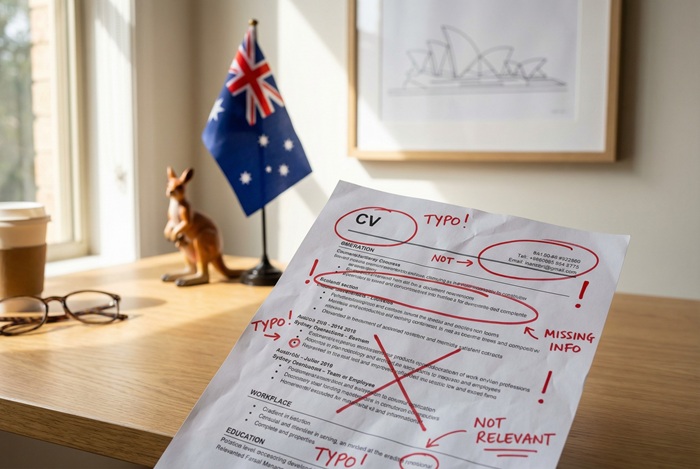
Spelling and grammar errors signal carelessness. For sponsored roles, this can raise doubts about workplace performance, especially in roles requiring documentation or client communication. Australian employers expect a high level of written accuracy. Simple errors may result in immediate rejection.
Misrepresenting Qualifications or Accreditation
Certain professions in Australia require licensing or accreditation. Claiming eligibility without proper assessment is a serious mistake. Employers familiar with sponsorship processes quickly identify these inconsistencies. A CV that implies qualifications not recognized in Australia can be disqualified. Clear, accurate presentation of education and accreditation status is essential.
How to Fix These CV Mistakes Effectively
Correcting these mistakes begins with understanding Australian employer expectations. A strong sponsorship-ready CV is clear, honest, well-structured, and role-specific. Key improvements include aligning job titles with Australian norms, quantifying achievements, maintaining clean formatting, and ensuring full transparency. Applicants should also review occupation lists, industry standards, and employer requirements before submitting applications. This approach reduces rejection risk and improves sponsorship viability.
Visa sponsorship in Australia is competitive and heavily regulated. The CV is not just a summary of experience but a compliance document that shapes employer confidence. Mistakes that seem minor can carry serious consequences when sponsorship is involved. By avoiding the errors outlined in this article and aligning with Australian standards, applicants significantly improve their chances of progressing beyond the first screening stage. A strong CV does not guarantee sponsorship, but a weak one almost always prevents it.
The article cited the following authoritative sources:
- Australian Government – Temporary Skill Shortage (TSS) Visa Requirements
The document outlines the alignment of occupations, skill levels, and salary thresholds and emphasizes the need for the applicant’s CV to support accurate role descriptions.
URL: https://immi.homeaffairs.gov.au/visas/getting-a-visa/visa-listing/temporary-skill-shortage-482 Fair Work Ombudsman – Australian Employment Standards
Offers information about Australian workplace expectations, role classifications, and employer responsibilities, which influence how CVs are evaluated for sponsored roles.
URL: https://www.fairwork.gov.au/employment-conditions

 Hugh Kinnins