 Hugh Kinnins
Do you know that applying for a German work visa begins long before stepping into an embassy or booking a biometric appointment? This is because the process usually starts with one document that shapes first impressions and determines who advances in recruitment: the curriculum vitae. Employers in Germany maintain a structured expectation of how a CV should appear, what it should contain and how efficiently it should convey a candidate’s qualifications. A well-prepared CV is not only a hiring requirement but also a key supporting document during the visa application stage. Consulates rely on it to verify an applicant’s career history, assess skill relevance and confirm the alignment between a job offer and professional background.
Because of this, many applicants discover that a general CV is not enough. German HR departments, immigration officials and recruiting platforms follow their own traditions of presentation. These standards have become familiar to companies across the country, and they influence hiring decisions. A clear checklist makes review easier and helps applicants avoid errors that lead to delays, rejections or simple misunderstandings.
The goal of this article is to ensure a CV that is clear, credible and aligned with what hiring managers and immigration officers look for when reviewing professional applications for Germany.
Understanding the Purpose of a German-Style CV
A CV for German employers differs from the versions common in some other regions. German recruiters prefer a structured, chronological layout. They expect exact dates, straightforward explanations and a tone that reflects professionalism without unnecessary embellishments. This preference for clarity is rooted in the country’s employment culture, where direct information speeds up the screening process and reduces uncertainty.
A German-style CV also plays a dual role. It helps employers evaluate whether a candidate meets the requirements of a specific role. It also assists visa officials in confirming that the applicant’s background aligns with the job that supports the visa application. The stronger the alignment, the smoother the verification stage.
For this reason, an applicant who prepares a meticulous CV increases the likelihood of success with both the employer and the embassy.
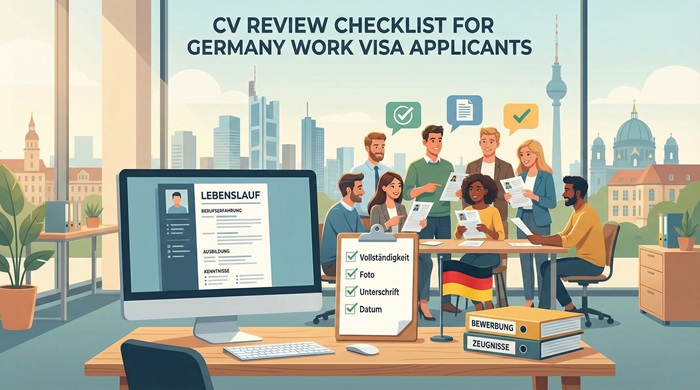
A Complete Review Checklist for Germany Work Visa Applicants
The checklist below is designed to help candidates refine their CV to meet Germany’s hiring expectations and the needs of the visa process.
1. Ensure Personal Information Is Complete and Error-Free
German employers expect brief but accurate personal details at the top of the CV. These details should be factual and presented without decorative language.
A review should confirm the following:
- Full name written as it appears on official documents
- Nationality
- Current address
- Valid phone number and email
- LinkedIn profile or professional website if useful
- Optional photo only when applying in fields where it is acceptable
Accuracy is important because immigration officers compare this information against passport details and application forms. Any inconsistency can slow the process or create confusion.
2. Use a Clear Professional Summary
A short professional summary is common in modern German CVs, especially for applicants with several years of experience. The summary helps employers understand the applicant’s core strengths within a few sentences.
For visa applicants, the summary should reflect the exact profession mentioned in the job contract. This helps establish that the candidate’s background matches the position listed in the visa sponsorship documents.
A review should confirm the following:
- The summary reflects the main profession.
- It highlights relevant experience.
- It avoids casual phrases or subjective statements.
- It remains factual and concise.
3. Follow a Strict Chronological Work History Format
A traditional German CV lists work experience in reverse chronological order. Each entry should specify the month and year of both the start and end date. Exact dates help employers verify skill progression and help embassies evaluate professional stability.
A review should confirm:
- Dates are written in the format Month/Year.
- Job titles match those on employment records.
- Company names and locations are correct.
- Responsibilities are written in clear, simple sentences.
- Achievements or results are measurable when possible.
Avoiding vague descriptions strengthens credibility. Each role should demonstrate a logical career progression.
4. Align Job Experience With the Visa-Sponsoring Role
Immigration officers scrutinize the CV to verify the applicant’s eligibility for the offered position. A review should verify that the experience listed on the CV supports the duties of the new job.
An applicant should confirm:
- Skills described match the job listed on the visa contract.
- Experience reflects the level required for the German role.
- Specialized training relevant to the role is included.
This alignment reduces the likelihood of requests for additional documents or follow-up proof.
5. Verify Educational Credentials and Professional Training
German employers expect a complete overview of educational qualifications, again written in reverse chronological order. The education section also serves as an important reference for immigration officials, especially when visas require recognition of foreign credentials.
A review should confirm:
- The name of each institution.
- Location of the school or university.
- Exact dates of study.
- Degree title written in its original form.
- Any certifications or additional training.
If an occupation is regulated in Germany, the CV should show qualifications that meet statutory requirements.
6. Include Skill Categories Relevant to German Employers
Recruiters in Germany appreciate structured skill listings. These may include technical skills, software proficiency, languages and industry-specific tools.
A review should check:
- Skills reflect those requested in the job advertisement.
- Language proficiency is stated using widely understood scales such as A1 to C2.
- Software tools or machinery are listed with clear labels.
This structured presentation helps both employers and immigration officials understand the applicant’s strengths at a glance.
7. Use Formal and Consistent Formatting
Clarity and structure are central expectations in German CVs. A review should ensure the CV looks professional and follows a simple, traditional design.
This includes:
- A clean font with readable size
- Uniform spacing
- No decorative elements
- Clear section headings
- Neutral color choices
Consistent formatting gives employers confidence in the applicant’s attention to detail.
8. Add Supporting Sections When Relevant
Some applicants benefit from additional sections, such as:
- Publications
- Conferences
- Volunteer work
- Technical projects
- Internships
- Apprenticeships
A review should confirm that any added section supports the applicant’s professional identity. Extraneous details should be removed.#
9. Ensure the CV Is Free of Claims That Cannot Be Verified
German employers and immigration authorities value accuracy. A CV that contains unverifiable claims may raise concerns.
A review should check:
- Job titles match employment records.
- Skills, certifications and awards are factual.
- Dates align with supporting documents.
Visa applications often involve cross-referencing, so factual consistency is essential.
10. Keep the CV Within an Acceptable Length
A typical German CV ranges from one to three pages depending on experience. It should be comprehensive yet focused.
A review should ensure:
- The document is neither too short nor overly detailed.
- Each section contributes clear value.
- The overall presentation remains organized.
11. Prepare a Version That Matches the Job Contract Exactly
Once a job offer is confirmed, the final CV version used for the visa process should match the employment agreement.
A review should confirm:
- The job title in the CV matches the contract.
- The skills listed match those required by the employer.
- The description of previous roles supports the responsibilities of the new role.
This helps immigration officials verify that the applicant is properly qualified.
12. Remove Informal Language and Maintain a Professional Tone
German CVs avoid narrative writing or subjective descriptions. The language should remain calm, direct and factual.
A review should check:
- No first-person pronouns are used unnecessarily.
- Sentences are complete and grammatically correct.
- Tone remains formal.
A consistent tone strengthens the impression of professionalism.
13. Check for Digital Compatibility
Since many employers use Applicant Tracking Systems, digital compatibility can influence how a CV is processed.
A review should ensure:
- Text is selectable and not embedded in images.
- File format is PDF unless otherwise requested.
- Tables are used sparingly.
A clean PDF ensures smooth uploading during the visa process.
14. Prepare a Verification Folder That Matches the CV
During the visa application stage, applicants may be asked for documents that support the information listed on their CV. These items often include:
- Employment letters
- Certificates
- Pay slips
- Degree copies
- Training records
- Recommendation letters
The CV review must ensure that every key claim can be backed by an official document. This preparation reduces delays during embassy checks.
Why This Checklist Matters for Visa Success
A well-reviewed CV reduces uncertainty during recruitment and visa processing. When employers receive a clear, structured document, they can easily assess skill relevance. When embassies receive a CV that matches the job contract and supporting documents, they can validate the application more quickly.
Errors, unclear descriptions, missing dates or unverifiable claims often lead to embassy delays. A thorough review helps avoid these issues.
Final Note: Before submitting the CV for job applications or visa processing, applicants should run a final review:
- Confirm formatting consistency.
- Verify chronological accuracy.
- Cross-check details against official documents.
- Review spelling and grammar.
- Ensure the CV reflects the German style expected by employers.
This final review brings the document to a level that meets professional standards in Germany and supports a smooth visa application process.
The article cited the following authoritative sources:
Federal Government of Germany – Make it in Germany
- This is the official portal of the German Federal Government for qualified professionals. It explains German CV standards, application expectations, and how CVs are used in work visa and Blue Card processes. https://www.make-it-in-germany.com/en/
German Federal Foreign Office (Auswärtiges Amt)
- This source explains how embassies and consulates evaluate work visa applications and supporting documents, including CVs, employment history, and qualification alignment. https://www.auswaertiges-amt.de/en
European Commission – Europass CV Guidance (Germany)
- Europass provides standardized guidance on CV structures used across Europe, including Germany, with an emphasis on chronological order, verifiable information, and professional presentation. https://europa.eu/europass/en/create-europass-cv
Anabin Database—German Recognition of Foreign Qualifications
- This database is used by German employers and immigration authorities to verify foreign degrees listed on CVs, supporting the section on education and credential verification. https://anabin.kmk.org
Federal Employment Agency of Germany (Bundesagentur für Arbeit)
- This agency outlines employer expectations, skill alignment, and labor market needs that influence both hiring and visa approval decisions. https://www.arbeitsagentur.de/en


 Hugh Kinnins